
Connecticut Recent Arrests
No single feed holds Connecticut recent arrests. The state kept its geographic counties. But county government was dissolved in 1960, and county jails folded into the Department of Correction in 1968. That history shapes every search today. The paper trail for a fresh arrest starts local. It begins with the municipal police department or the Connecticut State Police troop that made it. Each agency picks its own log format, release schedule, and photo policy. The DOC lookup covers current state custody only. It is not a list of arrests from the last day.
Start with the town where the arrest happened. A local log may list adult charges, dates, court, bond, and incident notes. A DOC result shows where a person stands after processing. Neither view is whole. Logs run late, leave out protected or juvenile matters, or list only selected events. Charges can change or get dismissed, so the court file must be read separately.
Note: Municipal police sources can differ in coverage, update time, field labels, and photo display even when they serve nearby towns.
The official Connecticut Judicial Branch criminal information page lays out the court lookup routes and links straight to the case search.
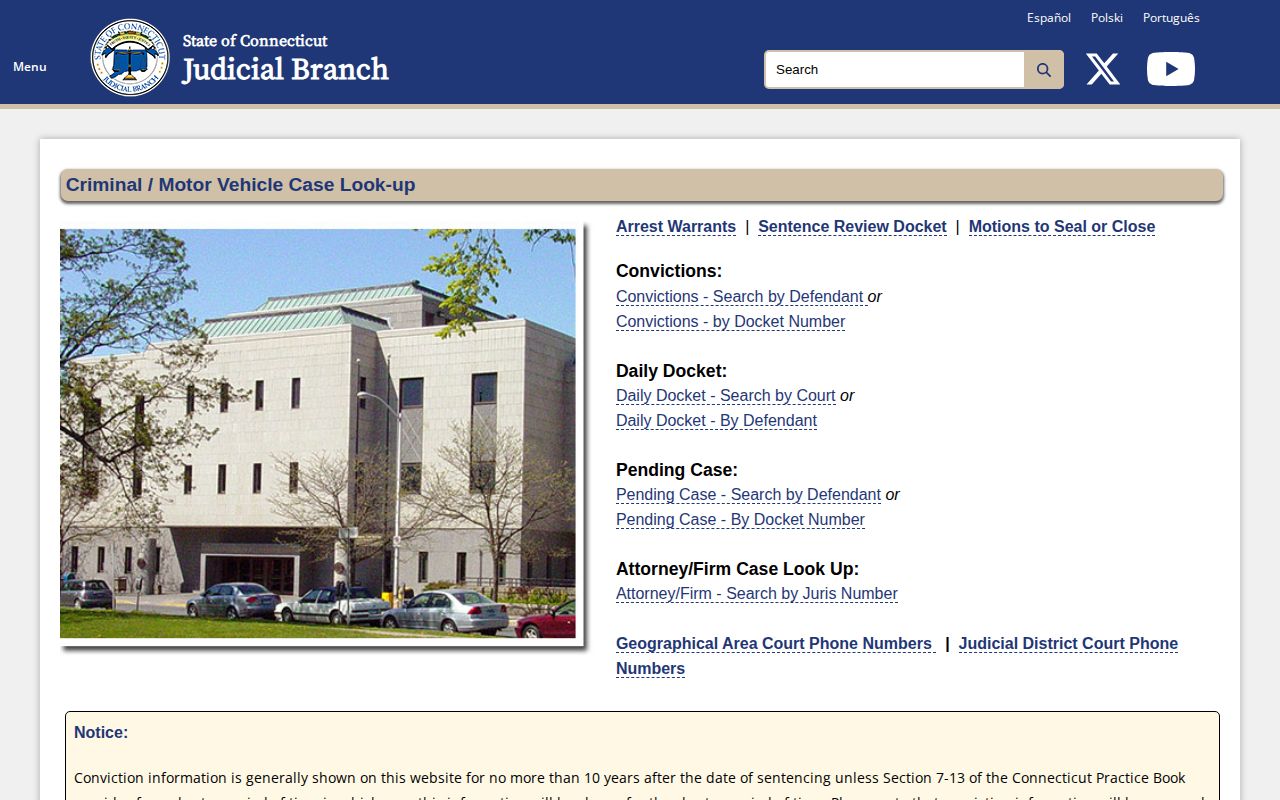
A court search helps confirm a case or its outcome. It is not a live police feed or a full criminal-history report.
Connecticut Arrest Routing
County names still help as geography. They do not point to a county sheriff or a county booking desk. The locality directory lists county areas plus cities with their own subdomain pages. Pick the place of the arrest. Open its link, and see which police source covers that jurisdiction. A city police department can publish its own reports. That holds even when the town sits inside a bigger geographic county.
Norwalk, Hartford, Bristol, Bridgeport, Danbury, and New Britain show why the source's own label matters. Norwalk posts daily logs. They carry a set morning generation time. A rolling PDF spans about a week. Hartford releases arrest-log PDFs in daily or near-daily batches. Bristol dates its blotter PDFs but may group several days around holidays. Bridgeport links to monthly arrest-log PDFs. These are city records, plain and simple, not county feeds.
Norwalk Police Daily Logs note that the log is generated automatically at 6:00 a.m. The published PDF is text rather than a photo roster.
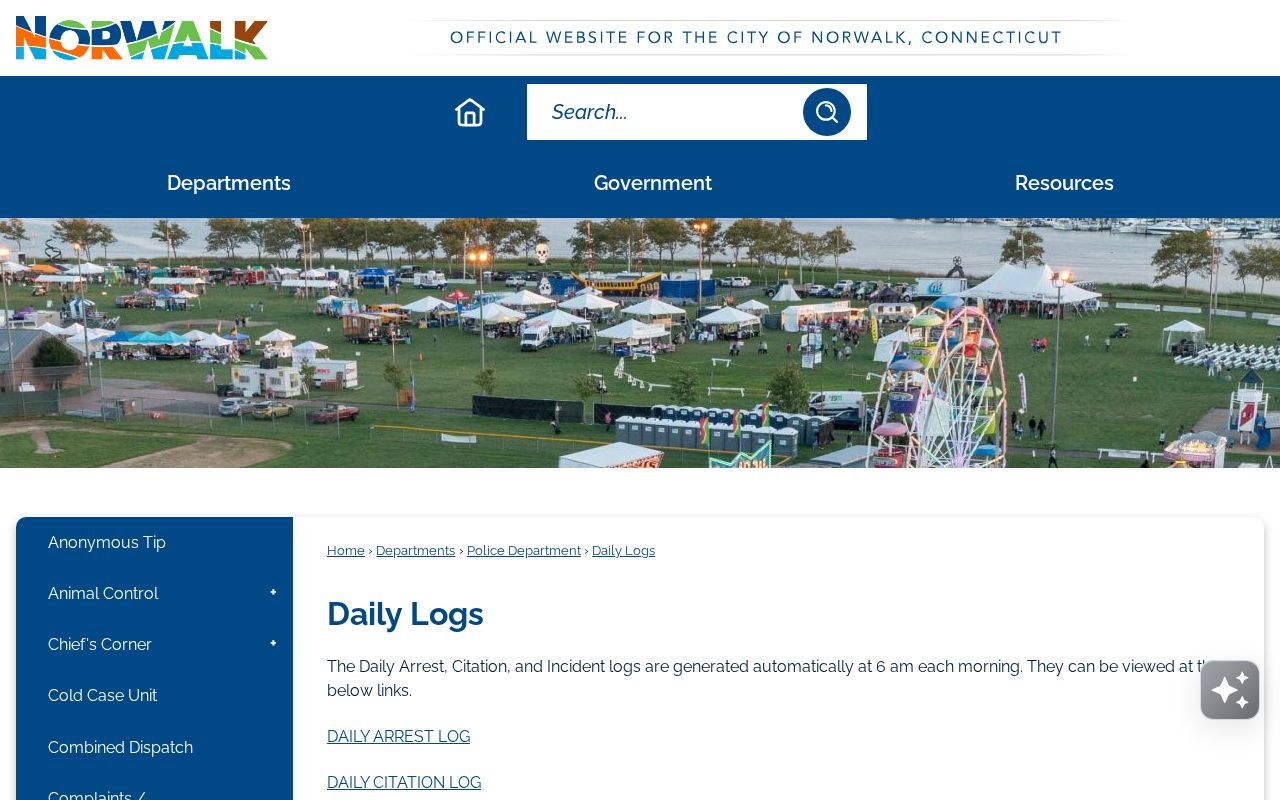
Read the date range and update time before assuming an entry is missing. A county page can route you. Only the named agency can confirm its own record.
Note: The official window shown on a PDF can be wider than the page title or navigation label suggests.
Find a Connecticut Arrest Today
For a possible arrest within the last day, go to the agency that handled it. Start there before any general custody system. Connecticut has no statewide same-day booking page. Someone may still be in local processing. The person may already be released or not yet on a court docket. The DOC locator only matters once a person is in DOC custody. The same-day page compares Norwalk, Hartford, Bristol, and other municipal views. It lists their windows. It also gives next steps when nothing shows.
Work in this order. That way a blank web entry is never mistaken for proof that no arrest occurred:
- Identify the town or city where police may have made the arrest. If the location is uncertain, list likely towns rather than relying on a county label alone.
- Open that police department’s official daily log or public safety portal and read the date range, adult-only limits, and last-updated note.
- Check the municipality’s records page or call its records unit when the log is absent or stale. Ask whether a releasable arrest report or booking image exists.
- Search the court docket after a case is opened, then use DOC only for a current state-custody question.
A fresh arrest can land in a police system before any PDF exists. Someone released quickly may never appear in DOC custody at all. Treat a "no result" as one source's answer for one search at one moment.
Note: A same-day feed is a snapshot of one source, not statewide confirmation of every arrest or release.
Which page covers the same-day window? Find the statewide comparison of last-day feeds and the verify path on Arrests Last 24 Hours.
Connecticut Police Blotters
Multi-day logs are not one type of record. A city PDF might be a full adult arrest list. Or it might be a weekly sample of police activity. It could also be a month-end archive. Connecticut State Police put out selective news releases. You get enforcement roundups too, not a daily dispatch log. News stories add color but cannot stand in for a police, court, or DOC source. Check the post date against the arrest date before calling an event recent.
| Source | Window or purpose | Photo / status limits |
|---|---|---|
| Municipal police log | Daily, rolling, weekly, or monthly depending on the town | Most reviewed PDFs are text; scope is local |
| Connecticut State Police press releases | Selected high-interest incidents and enforcement notices | Not every CSP arrest; some releases may include an image |
| Judicial Branch case lookup | Docket, hearing, and disposition information | Not an immediate booking feed or complete history |
| DOC Inmate Information Search | Current state custody | Not a recent-arrest roster; no consistent public photo field |
| CT VINE / VINELink | DOC custody and Judicial Branch event alerts | Opt-in notification, not every municipal arrest |
Bridgeport keeps monthly arrest-log archives. Danbury posts date-range logs, and New Britain publishes selected blotter material. For a wider time span, the statewide Police Blotter page explains weekend and archive patterns across these official sources.
Connecticut Booking Records
A Connecticut arrest record rarely lives in one place. The department that made the arrest keeps the original paperwork and identifying material. The court file tracks what happened to the case. If the person ended up in state custody, DOC holds that piece too. None of these merge into a single county booking record. So a smart request names the custodian and the exact record you want. Don't ask for everything statewide.
| Record field or layer | What it can show |
|---|---|
| Name and basic identifiers | The person named in the arrest record, subject to legal redactions |
| Arrest date, time, and offense | The event and charge recorded at arrest |
| Warrant application or arrest report | Underlying public arrest record material, with protected content withheld where law allows |
| Booking or identification photo | An image held by the agency; public display is not guaranteed |
| Court docket and disposition | Hearings and the case outcome, which may differ from the booking charge |
| DOC number, facility, and status | Current DOC custody details when a matching DOC record exists |
The Connecticut DOC search guide says the locator takes a DOC number, a last and first name, or a date of birth, and it warns that the status shown can shift at any time.
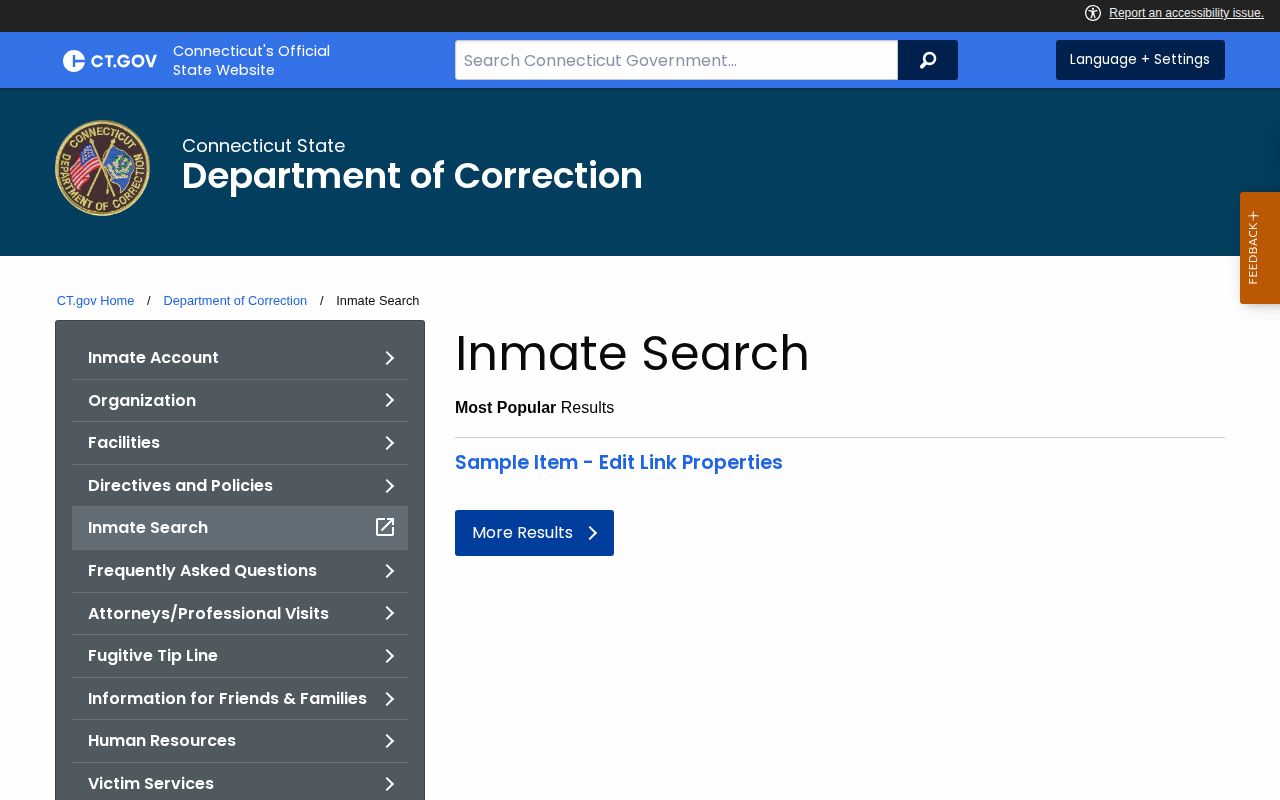
The search gateway leads to the DOC lookup, which tracks custody only. It skips municipal arrest reports entirely. The live DOC locator leaves out ICE detainees and youthful-offender data, and its empty search screen is not a roster of recent bookings.
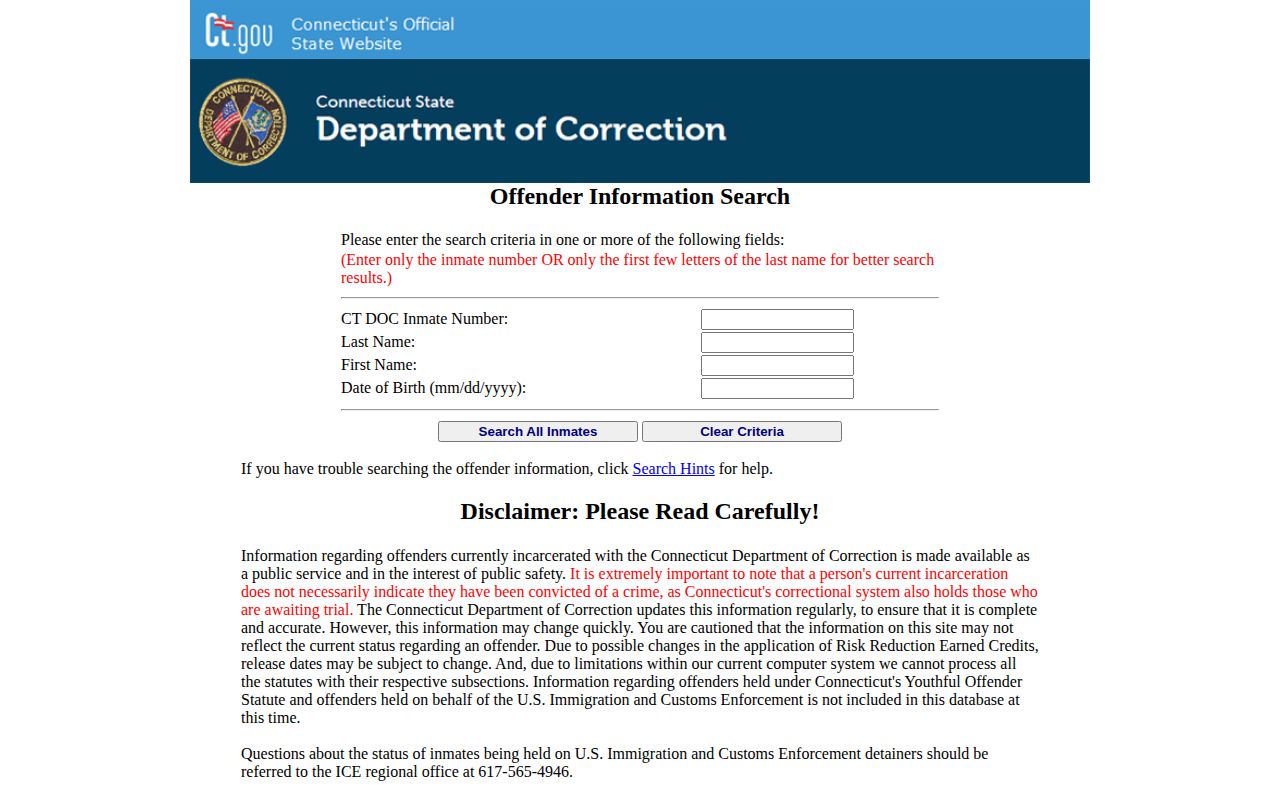
A name match deserves a second look. Confirm it against the official identifiers the locator displays before drawing any conclusion.
Note: Current custody and a historical arrest report answer different questions, so use the record holder tied to the event.
Connecticut Mugshot Sources
Connecticut has no statewide public booking-photo gallery. Most municipal logs are text-only PDFs. Norwalk, Hartford, Bristol, Bridgeport, Danbury, and New Britain publish no consistent photo field in those documents. A press release or public portal may carry an image in a given case, though an agency that photographs an arrested person is not obligated to post that booking photo for public searching. The honest answer is "not shown in this source," never "no photo exists."
Start with official sources. Ask the arresting department about its report or photo policy, turn to the court for case outcomes, and use DOC only when someone is in its custody. The DOC locator shows a photo inconsistently at best. Federal custody runs on a separate track; the Federal Bureau of Prisons locator finds federal inmates but posts no public booking-photo gallery, and its landing page notes that federal records sit apart from Connecticut municipal arrest records.
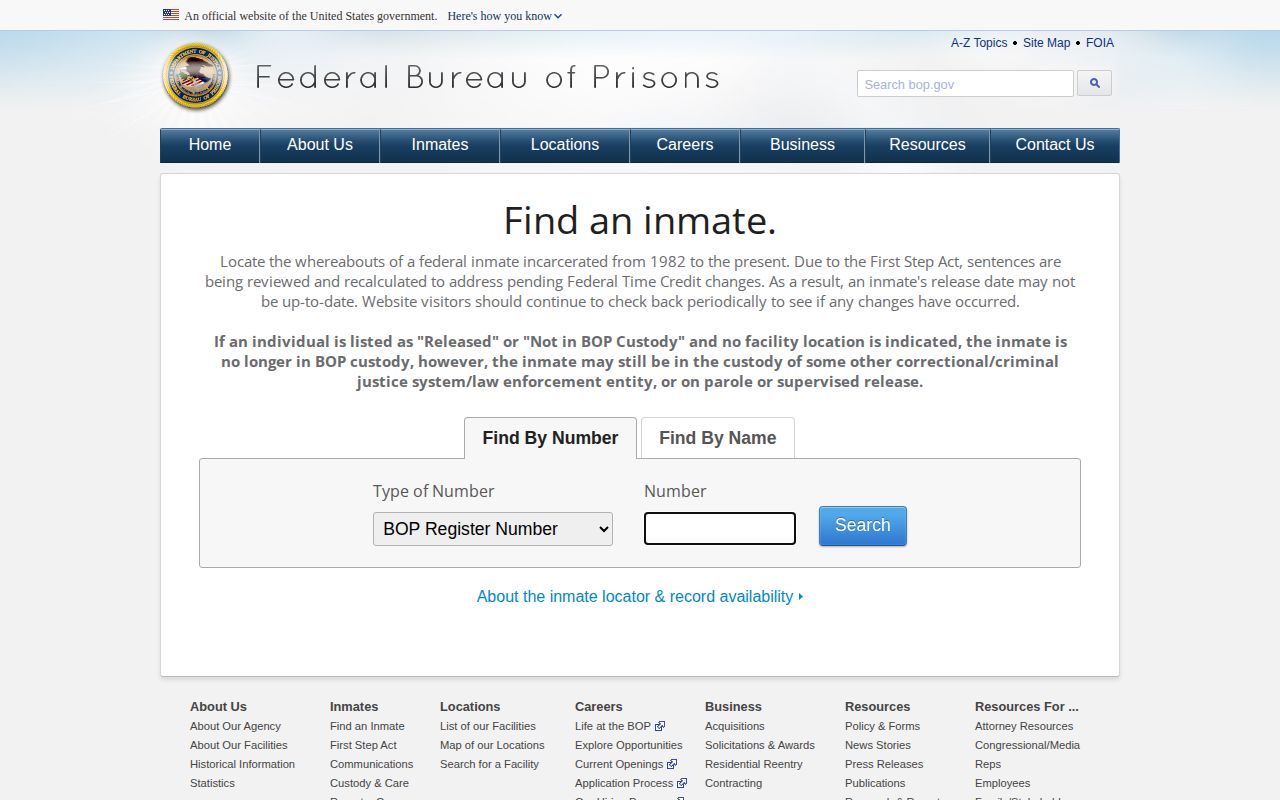
The BOP locator returns no booking photos. It cannot confirm any Connecticut state or local arrest. Beyond official sources, RecentlyBooked's Connecticut section and Mugshots.com's Connecticut page are unofficial secondary indexes. Their county labels do not match current Connecticut county government. Entries may be stale, incomplete, mislabeled, or long past any court outcome. Treat no aggregator count as an arrest total. Arrests.org and Mugshots.zone list no current Connecticut section. Busted Newspaper offers no verified one either. Its free removal policy could apply if a listing turns up. But a policy page proves nothing about Connecticut coverage.
The RecentlyBooked policy page lays out that site's own conditions, not any official Connecticut process. Accurate current public records generally stay put under its rules.
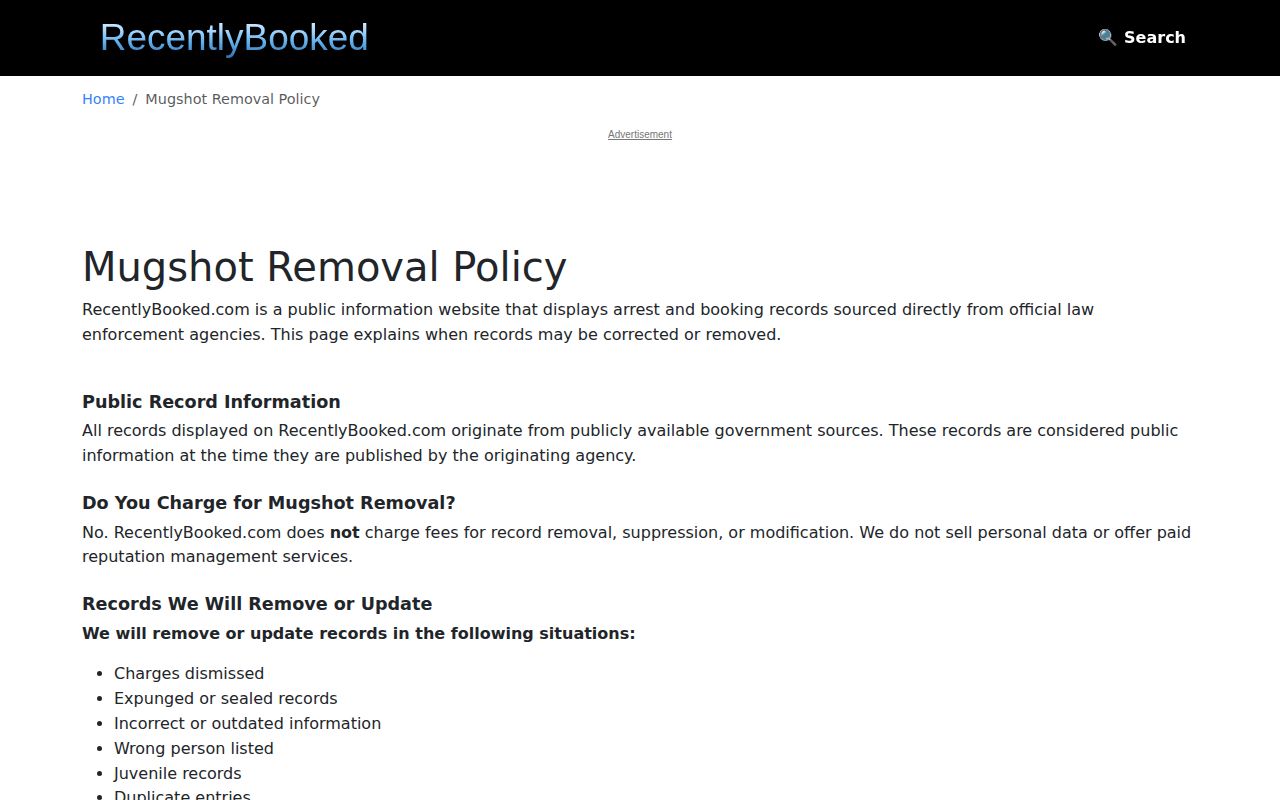
A correction route does not turn a private index into an official source. No faces are copied or shown here.
Request Connecticut Arrest Records
Connecticut's Freedom of Information Act opens public records to requesters, exemptions and redactions included. Section 1-215 makes the basic "record of arrest" public from the moment of arrest. It spells out core fields. These include name, race, address, arrest date and time, and the offense charged. A warrant arrest record carries the application and affidavit. A warrantless one carries the official arrest or incident report. Each item goes to the agency holding it. Connecticut has no statewide county sheriff for requests.
For a municipal arrest, find the local police department and file a focused request. For a Connecticut State Police matter, DESPP Reports and Records handles it through the official DESPP page. The DPS-96-C form covers criminal arrest and other report categories. It lists a non-refundable $16 search fee, plus $16 per copy where that applies. No fixed turnaround for arrest reports is promised.
- Give the agency the person’s name, municipality, approximate date, and incident or case number if known.
- Name each item: arrest report, CAD record, releasable photo, or another specific record.
- Ask whether a statutory exemption, redaction, or court order affects the response.
- Check the court docket for disposition and DOC only for current state custody; each is a separate record path.
Older logs call for patience. Go to the source archive, or ask the custodian for the retention schedule and series. A vanished PDF does not prove destruction of the official record, and an aged search result does not prove a case still stands open.
Connecticut Mugshot Law
Connecticut's arrest-record law draws a sharp line between public information and protected detail. Section 1-215 defines the public record of an arrest. It opens that record at the time of arrest. The covered record holds basic identifying facts. It also includes the date and time of the arrest, and the offense. Warrant arrests include the application and affidavit; warrantless arrests include the official report. Nothing in the rule forces a police agency to publish booking photos online.
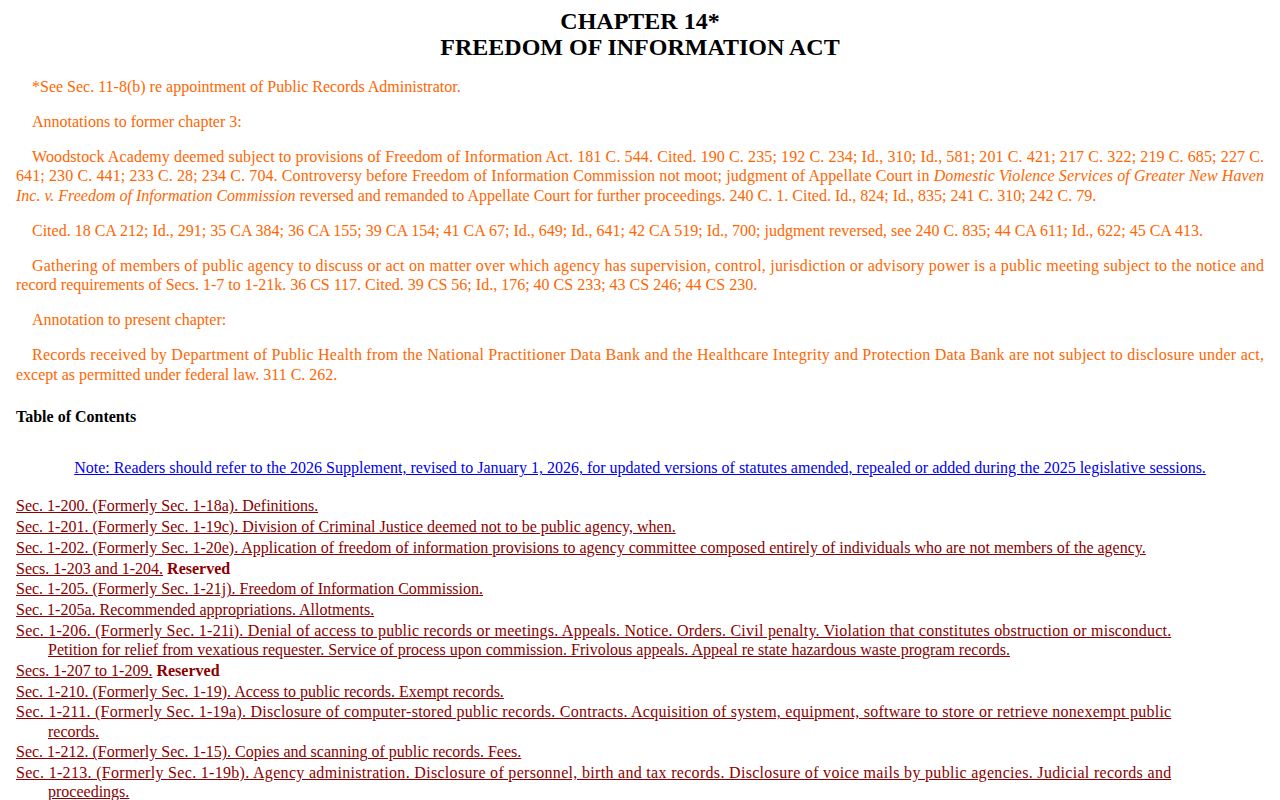
The Connecticut General Statutes, Chapter 14 carries the full arrest-record definition. It also lists exclusions for juvenile and erased matters. Witness identity, listed victim details, prosecution-sensitive content, and court-sealed material may all be withheld. Some of it may be redacted instead. Section 1-215 is the statute to read. It shows which arrest details are open and which stay protected.
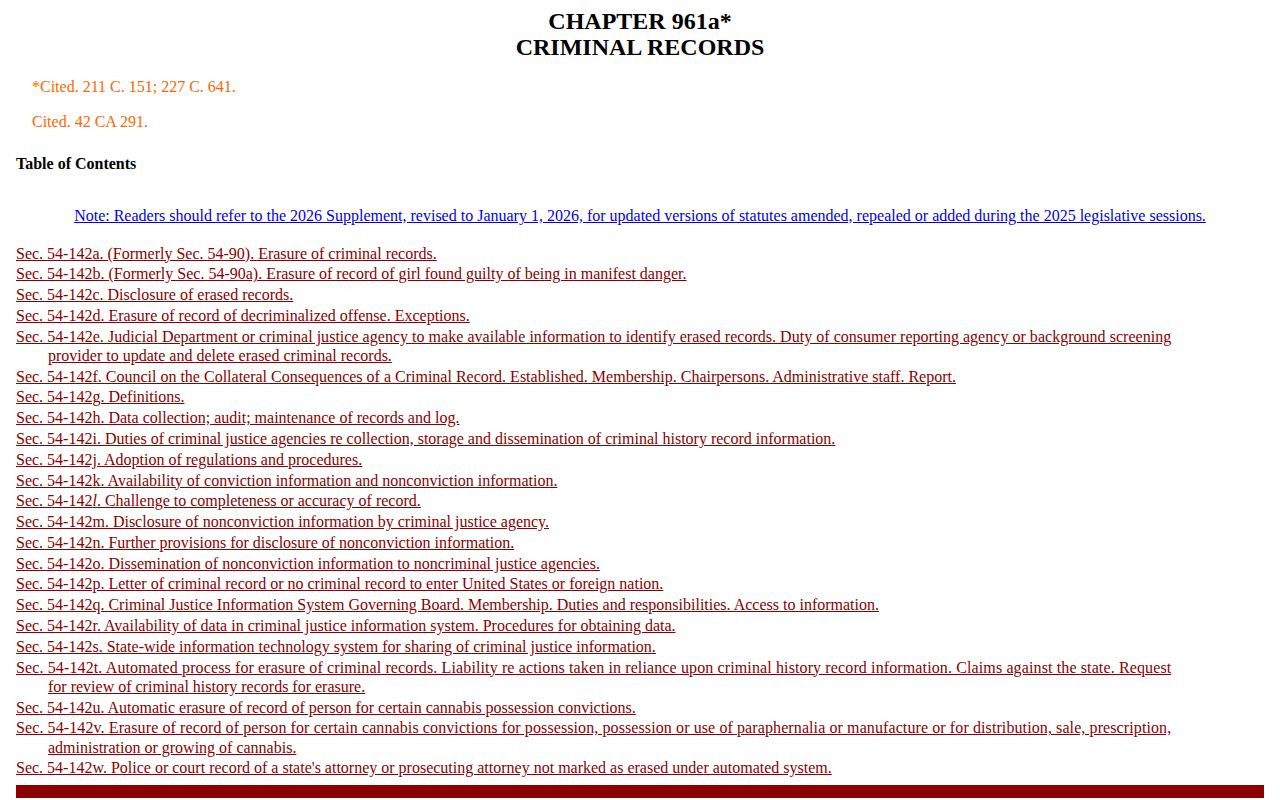
Connecticut law governs records, not photos. Section 1-17a and Chapter 529 speak to images and identification in other settings. Neither one creates a public gallery. Erasure anchors Connecticut's criminal-record law. Section 54-142a covers qualifying dispositions. Section 29-15 handles fingerprints, photographs, and physical descriptions when a person with no prior conviction is acquitted, has a charge dismissed, or meets the nolle rule. A separate rule, § 54-142e, reaches covered bulk recipients that buy or request at least 50 public records. After an erasure notice, those recipients must update and permanently delete erased records on the statutory schedule. That is not a universal free takedown law. The erasure statutes in Chapter 961a distinguish official erasure from copies held by independent publishers.
A dismissal, a nolle, a seal, and an acquittal each mean something different. Courts do not erase news archives. Search results can linger too. Never pay an unverified intermediary who only promises photo removal. The court, the police records division, and a covered bulk recipient each follow separate duties and processes. Some unofficial publishers advertise free correction or erasure procedures. Those are private policies, often requiring court proof. A policy page cannot guarantee that a Connecticut listing exists or that removal will happen.
Section 1-215 makes certain arrest records public. It still does not force police to post booking photos or run a statewide mugshot search.
Note: A free publisher policy is separate from the official erasure process and does not guarantee a listing will be removed.
Connecticut Arrest Warrants
The Office of Policy and Management's arrest-warrant data page links to the Judicial Branch public warrant search. The public tool mainly shows violation-of-probation and failure-to-appear warrants. It is not a full live list. OPM posts monthly data summaries. Broader operational detail stays inside authorized law-enforcement systems. To check a possible match:
- Search the public interface and note its case type, date, and stated status.
- Confirm an apparent match with the relevant court clerk or counsel; names alone can be ambiguous.
- If the concern is about your own warrant, contact the court, a lawyer, or law enforcement for instructions instead of relying on a blank search.
An empty public result does not mean no warrant exists. Never approach anyone you believe is wanted.
Call 911 for an immediate threat. For a non-emergency tip, keep your distance and reach the official agency instead of confronting anyone.
Connecticut offers a few ways to report or search for wanted people. State Police accepts tips through its Your Help Is Needed page. The Department of Correction takes anonymous fugitive tips at 860-297-6574 and CT.FUGITIVE@ct.gov, both listed on its contact page. For federal cases, the U.S. Marshals Service runs a federal wanted search of its own. None of these forms a full statewide most-wanted roster. Each covers its own agency only, so treat them as separate routes. How broad is the online warrant search? It covers a limited public category, so confirm any possible match with the court or a lawyer before you act on it.
Connecticut Court and DOC Records
A record trail shifts as a case moves. The police log captures the arrest event itself. The Judicial Branch case lookup can show a docket, hearing, or charge once a case opens. Disposition appears there too. DOC lists current state custody after a person enters its system. Federal BOP and ICE searches stand apart and say nothing about Connecticut state court. Never join records by name alone when identifiers do not match.
| Stage | Best source | What it does not prove |
|---|---|---|
| Police arrest | Arresting municipal department or CSP | Guilt or final case result |
| Court case | Connecticut Judicial Branch | Current custody or full criminal history |
| DOC custody | Connecticut DOC locator | Conviction, if a person is awaiting a case |
| Federal custody | BOP or USMS sources | Connecticut state or local booking details |
Booking is the record made after an arrest. Arraignment is the first court appearance. Bond is a release condition the court sets. Disposition is the recorded outcome, while erasure is Connecticut's term for removing eligible criminal-record material from public access.
- Booking
- Recording and processing an arrest at the responsible agency.
- Arraignment
- A court appearance where the case begins and release terms may be addressed.
- Disposition
- The court’s result, such as dismissal, nolle, acquittal, or conviction.
- Erasure
- A legal process that restricts or removes eligible official criminal records under Connecticut law.
A booking charge can change as a case moves forward. Custody status simply shows where a person is held right now.
Note: A court disposition can change the meaning of an arrest entry, but the booking charge alone is not that outcome.
Connecticut Arrest Record Archives
Archive depth varies by town and record series. A daily PDF may roll off while a monthly index stays online. News stories can sit behind an archive service. Retention schedules control how long an agency keeps a record. They say nothing about copies on search engines or third-party sites. No single retention period fits every Connecticut booking photograph. The Connecticut State Library collections preserve records of lasting historical value. They explain how to search finding aids. They do not automatically hold every municipal blotter or booking image. Old prison records are not a current arrest roster. For a recent police record, go back to the agency that created it. Ask which retention schedule applies.
Note: An old PDF or search result is evidence of publication history, not evidence of guilt or present custody.